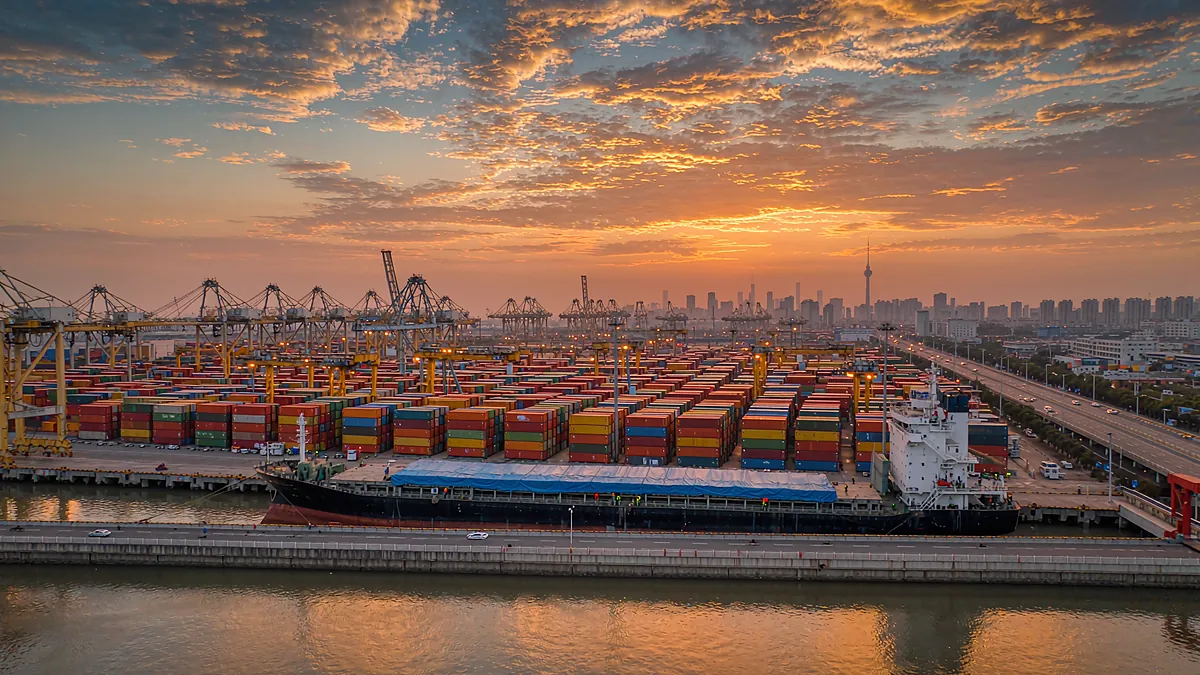
The Bottleneck Has Moved Offshore: Singapore Berth Waits of Three to Five Days Lift Intra-Asia Rates by 9.2%
On 16 October the Shanghai Containerized Freight Index closed at 3,679.58 points, up 0.42% and higher for a second consecutive week. Look inside the sub-indices, however, and the market is moving in opposite directions. The Mediterranean leg gained 8.3%, Southeast Asia rose 9.2% to USD 449 per TEU and Europe added 2.7%, while US West Coast fell 0.8%, US East Coast 1.1%, South America 6.7% and Australia/New Zealand 7.6%. Deep-sea trades are softening; intra-Asia is not.
The intra-Asia increase is not a demand story. Congestion at Chinese gateways has largely cleared: average waiting time over seven days is about 2.61 days at Shanghai, 1.29 days at Shekou and 1.65 days at Yantian. The pressure has moved to the transshipment end. Berth waits at Singapore's PSA terminals run three to five days, average arrival and departure delays exceed four days and yards are close to full. Kuehne+Nagel, citing platform data, puts average arrival delay at 4.48 days and departure delay at 4.3 days over the past 30 days, with 55 vessels working alongside and 11 waiting at anchorage. PSA's response is blunt: berth priority is allocated by yard capacity, so vessels that load a lot of export cargo come alongside first, while those discharging heavy transshipment volumes and loading little wait longer at anchor. During the yard squeeze, PSA has also restricted new transshipment cargo entering the terminal.
For a single booking, that means the gap between direct and transshipment routing is wider than two days of sailing. A transshipment box sitting three to five extra days at a hub drags demurrage, storage and working capital with it, and that cost rarely appears on the quotation.
Further west, the far end is tighter still. Africa remains the worst-performing region for waiting time: Conakry at 13.33 days, Beira at 9.33 days, Durban at 5.73 days with Pier 1 delays of seven to ten days and DGT delays of ten to sixteen, and Tema at 5.59 days. At Colombo, inter-terminal transshipment backlog has risen from 36,000 TEU to 53,000 TEU and some carriers have temporarily dropped calls. C.H. Robinson estimates in its October report that about 12% of global container vessel capacity is absorbed by port congestion, the highest in four years.
That 12% is worth pausing on. It means a gap has opened between nominal and effective capacity, and the gap is being filled by omitted calls, rolled cargo and delayed transshipment. Whoever absorbs the fill absorbs the bill.
Four practical steps for shippers.
First, compare direct and transshipment routings on one sheet rather than on ocean freight alone. A Singapore routing may quote twenty or thirty dollars cheaper, but five extra days of dwell usually costs several times that difference. Switching to Port Klang West or Tanjung Pelepas is a workable alternative; Westport is currently running about 1.63 days of waiting, though yard utilisation there is also in the 85% to 90% range, so the buffer is thin too.
Second, rebuild all-in rates for Africa on the latest waiting times. Durban, Beira and Conakry now have to be measured in weeks. Free-time should be counted from actual container pick-up, not from discharge, and quotes not yet confirmed should carry a line stating that surcharges and routing are subject to the date of effect.
Third, quote transit time as sailing days plus a transshipment buffer: five days for Southeast Asia, ten to fourteen for Africa, seven for the Middle East. That is not conservatism; it is writing a delay that is already happening into the commitment.
Fourth, re-confirm release and gate status at Yantian and Shekou the day before loading. Yard utilisation at Shekou is above 90%, berth priority for large discharge vessels gets squeezed, and the window for a late re-allocation is about half a day.
The easiest misreading of this market is that the index looks flat while costs are climbing. Budgeting off the composite index will systematically understate the transshipment leg.